




Every conversation about AI in the enterprise eventually gets back to the same question: why are some companies making progress while others stay stuck in pilot purgatory?
We sat down with Prasad Ramakrishnan, a seasoned CIO and advisor at dotSolved, to get his perspective on this. What came out of that conversation was not a technology framework. It was something more fundamental, a set of behavioral and organizational patterns that separate the companies getting AI right from the ones still spinning their wheels.
Prasad states the three things that stood out from that conversation which had nothing to do with technology selection and everything to do with how organizations behave when they are serious about change.
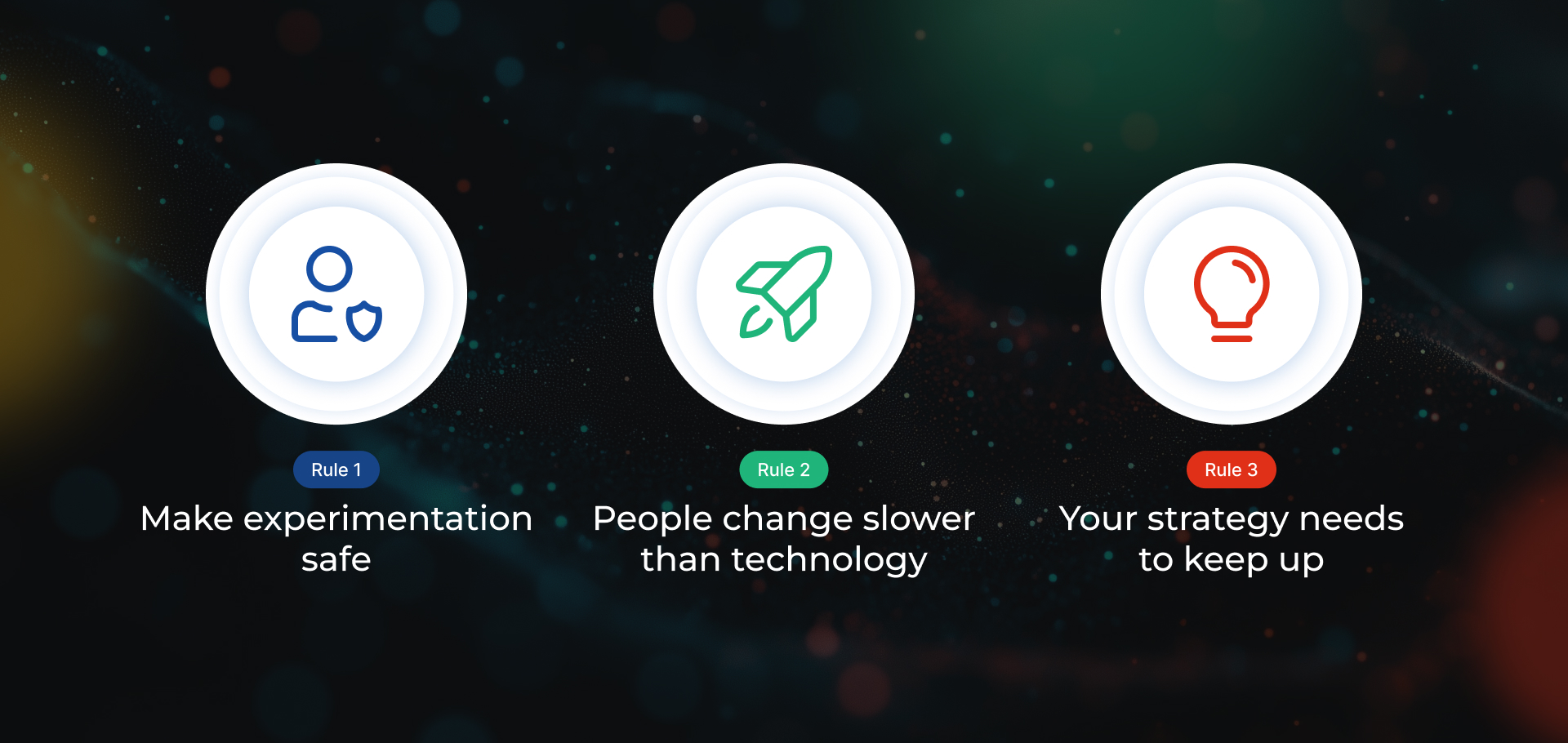
Rule 1 – Fail Fast, and Actually Mean It
Companies making meaningful progress with AI have done something that sounds obvious but is surprisingly rare. They have given their people genuine permission to try things that might not work, and more importantly, they have built the conditions that make that permission credible. Leadership is not simply tolerating failure but actively creating an environment where experimentation is expected behavior, with cover when something does not pan out and a mandate that flows through every level of management rather than staying confined to announcements from the top.
The structure that makes this work in practice is a cross-functional Center of Excellence. Not a slow-moving governance committee, but a standing body with a shared charter to evaluate ideas, run experiments, and decide collectively where to go next, drawing from across the business:
- IT and Information Security
- Finance and Legal
- Sales, Marketing, and HR
The cross-functional nature matters because AI opportunities rarely live neatly inside one department. A process improvement surfaced by sales almost always has implications for marketing, finance, and operations simultaneously, and a siloed team will miss that entirely.
Why this moment is different
AI is not a faster way to do the same things. It is a new capability that makes certain processes obsolete and enables entirely new ones, much like the industrial production of steel made skyscrapers possible when only small buildings existed before. Companies treating it as an incremental upgrade are missing that entirely. The ones making progress have accepted that their core business processes may need to be rebuilt from the ground up, and they are running experiments to figure out what that looks like.
Rule 2 – Do Not Underestimate Change Management
If the first rule is about speed, the second is about patience. Change management moves on its own timeline, and trying to rush it consistently backfires.
The difficulty is not that employees fail to understand that things are changing. Most people do. The harder truth is that knowing change is coming and being ready to change how you work every day are two very different things. A lead comes in, you open it, you research it, you enrich it, you pass it along. That sequence is not just a process on paper. For many people, it is the definition of what doing their job well looks like. Asking them to tear it up is asking them to question everything they know, and that kind of unlearning takes time and trust that most organizations do not budget for.
When leadership communicates a change once and moves on, employees read the signal and quietly return to the old way. The change never takes root. What works instead is a cascading communication structure:
- Company all-hands – The CEO and senior leaders address the change directly in front of the entire organization, making clear this is a business priority, not an IT initiative.
- Departmental all-hands – The team driving transformation gets a dedicated seat at the table in each department to explain what is changing and why the old way is no longer adequate.
The goal is to make sure employees see their manager, their department head, and senior leadership all treating it with the same seriousness. That alignment is what gives a change program its staying power.
The talent question
Those earlier in their careers tend to pick up these tools without the weight of ingrained habits. They do not need to unlearn before they can imagine something new, and that matters more than most hiring conversations acknowledge. The organizations moving fastest have figured out how to pair that with the institutional knowledge that longer-serving people carry, rather than letting the two work against each other.
Rule 3 – Keep Your Eyes Open
The third rule is less about execution and more about orientation. The pace of change in this space is faster than any transformation cycle most CIOs have navigated before. New capabilities, new tools, and new competitive realities are appearing at a rate that makes even a quarterly review cadence feel slow.
Companies struggling are often the ones treating their AI strategy as a one-time decision rather than an ongoing discipline. One of the specific risks this creates is AI fragmentation, which happens when individual business functions each select their own tools in isolation.
Think about a company where half the workforce is on Slack and the other half is on Microsoft Teams. These two groups are talking within their own walls but not between them. The same dynamic plays out when AI tools proliferate without a common layer underneath.
The answer is not to lock the organization into a single rigid standard that cannot evolve. It is to establish a core enterprise stack that the Center of Excellence governs and maintains, while making deliberate, considered exceptions when a specific function genuinely needs something different.
The fragmentation that slows organizations down is almost never the result of a conscious decision. It accumulates quietly, until the cost of untangling it is significant.
What This Looks Like in Practice
The organizations making real progress with AI are not doing something radically different from what others are attempting. The difference is in how seriously they treat the work that sits around technology. They step back from each business flow, assemble cross-functional teams, and ask a harder question than most are willing to sit with.
Given what is now possible, how should this process work?
That is a fundamentally different exercise from most AI pilots, which tend to treat existing workflows as fixed and look for places where a step or two can be automated.
This is the same question dotSolved starts with when working with clients. The approach follows a deliberate sequence:
- Diagnose – An honest assessment of where the organization actually stands, its processes, data, and readiness, before any recommendations are made.
- Design – Defining what a better future state looks like for that specific business, not a generic template.
- Enable – Getting people and systems ready to operate in that new environment, where change management, training, and integration move together.
- Scale – Expanding only when the foundation is genuinely ready to carry it.
Each stage maps directly to the discipline the three rules demand. The willingness to experiment honestly, the commitment to bring people along properly, the awareness to keep adjusting as the landscape shifts.
The companies getting AI right are not the ones with the most resources. They are the ones that decided to move, to manage the change honestly, and to keep watching.