




Quota attainment is falling. Cycle times are stretching. And the operational gap between revenue teams that have rebuilt their architecture and those that have not is widening every quarter.
Ask your top account executive how much time they spent last week actually talking to customers. Most will tell you something that does not add up to a full week of selling.
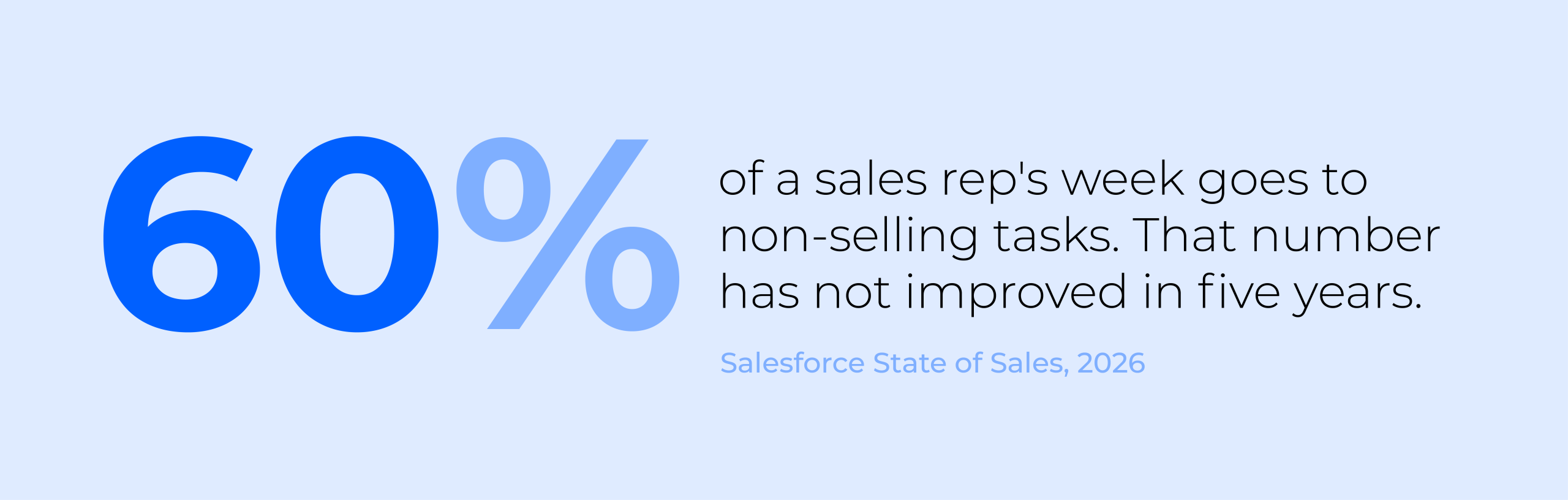
It is not a perception problem. Salesforce’s own 2026 State of Sales research put a number on it: reps spend 60% of their week on non-selling tasks. Internal meetings, CRM updates, manual data entry, lead research. Only 40% of the week goes to actual selling activity. For a CRO managing a team of 20, that is the equivalent of 12 people not generating revenue, every single week.
At the same time, global quota attainment dropped to 43% in 2025, down from 52% the year before. Win rates sit at around 20-21%. The average B2B sales cycle has stretched from 4.9 months in 2019 to 6.5 months today. None of these trends are moving in the right direction, and the reason is structural: the sales operation was built for a world where humans managed every handoff between tools. That world has changed. The operation has not. And the answer is already sitting inside your Salesforce instance.
The gap is not about AI. It is about who has operational infrastructure and who does not.
87% of sales organisations now use some form of AI, according to Salesforce’s 2026 research. What that number masks is the difference between organisations that bolted AI onto existing workflows and those that rebuilt the workflow around AI.
McKinsey’s 2025 State of AI research found that only 39% of organisations report any measurable improvement in business outcomes from AI investment. The consistent reason: teams add AI on top of broken processes instead of redesigning the process. The result is a faster broken process, not a better one.
“The teams pulling ahead are not using more AI. They are using agentic AI that acts across all their tools without a human managing every handoff.”
What agentic AI actually changes for revenue teams.
Agentic AI is different from the automation tools most sales teams already use. Automation follows rules someone pre-configured. An AI agent decides its own next action based on context, data, and defined outcomes. It does not wait to be told what to do next. The practical difference shows up in three specific places:
- Lead response time – Analysis of 253,817 lead responses across 127 B2B companies found that responding within five minutes produces 21x higher qualification rates than responding after 30 minutes (Artemis GTM, 2026). Agents eliminate the manual steps between a signal arriving and a rep acting on it. Response time becomes an infrastructure variable, not a people variable.
- CRM data quality – Only 35% of sales professionals currently trust their CRM data’s accuracy (Salesforce, 2026). Agents that log every interaction automatically produce a CRM that gets more accurate every week. Forecasting models trained on that data get more precise every quarter. Teams running on manually entered data stay at roughly the same accuracy level indefinitely.
- Retention signals – 74% of B2B revenue comes from existing customers (ChurnZero, 2025). Agents that monitor usage patterns, support ticket velocity, and executive sponsor activity continuously route at-risk accounts to the right person before the renewal conversation starts. Churn becomes predictable. Intervention becomes possible.
The compounding problem: why waiting costs more than moving.
In most technology cycles, being 12 months late means you spend 12 months catching up. Agentic AI does not work that way. Teams that automate CRM now build more accurate forecasting models every month. Teams running on manual entry stay at the same accuracy level indefinitely. The data quality advantage does not transfer. It compounds.
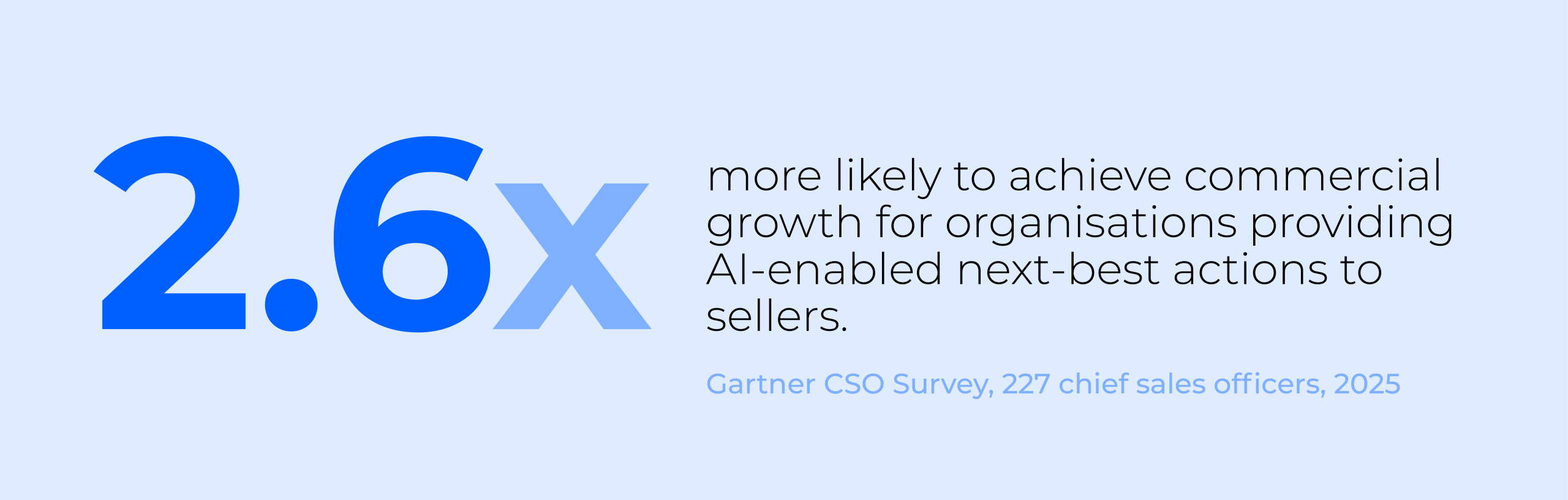
Gartner’s May 2026 CSO research, conducted across 227 chief sales officers, found that organisations providing AI-enabled next-best actions to sellers are 2.6 times more likely to achieve commercial growth. The organisations that built that infrastructure in 2025 are 2.6 times more likely to hit their number in 2026. The ones that build it in 2027 will be 2.6 times more likely in 2028.
The gap between teams that have rebuilt their revenue architecture and teams that have not is widening every quarter. That is the window that is narrowing.
You are already paying for the infrastructure. The question is whether it is switched on.
The AI sales tool debate has moved on from whether to invest, to which one. Gong, Outreach, and Copilot for Sales each solve a real slice of the workflow, but none of them run on your Salesforce data natively. They sync, they copy, they bridge, and every bridge is one more thing that can drift or break. For teams already on Salesforce, the smarter move is AI that lives where your data already does.
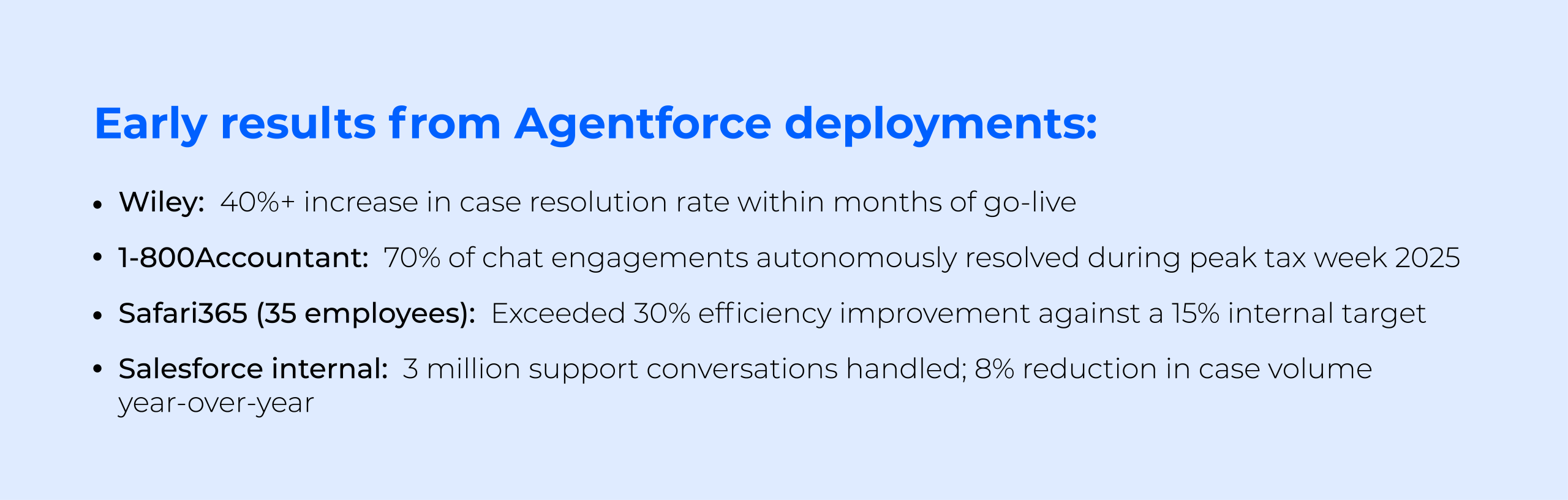
Agentforce is Salesforce’s native AI agent platform. It runs inside your existing Salesforce instance, connects to your existing data via Data Cloud, and integrates with your ERP and support stack via MuleSoft. The agentic AI capability your revenue team needs does not require new infrastructure or a rip-and-replace. It requires the implementation expertise to configure agents against your specific sales motion and go live without a six-month project.
The teams that have done this well share one pattern: they started with workflow design, not configuration. That is what separates a 30-day go-live from a project that never quite works as expected.
dotSolved implements Agentforce for mid-market revenue teams and gets them live in weeks, not quarters.
Want to see how it would work for yours? Let’s connect
Sources
- Salesforce State of Sales, 2026: salesforce.com/news/stories/state-of-sales-report-announcement-2026
- McKinsey State of AI, 2025: mckinsey.com, November 2025
- ChurnZero Customer Revenue Leadership Study, 2025: churnzero.net
- Artemis GTM, Speed to Lead Benchmark 2026: artemisgtm.ai/research/speed-to-lead-benchmark-2026
- Salesforce Agentforce Customer Success Stories, 2025-2026: salesforce.com/agentforce/metrics
- AeolusGTM Research, The State of B2B Revenue 2026: aeolusgtm.com/reports