



A gap-by-gap look at what changes operationally when agentic AI runs inside your Salesforce instance.
Ask any CRO at a company between $200M and $1B where their revenue is leaking and you will not get a vague answer. They know. Lead response is too slow. CRM data is unreliable. Outreach has no coordination across channels. Churn signals arrive too late. Forecast accuracy depends more on optimism than facts.
The gaps are not a mystery. What has been missing is the infrastructure to close them systematically, rather than through more effort from the same people using the same tools.
Agentforce does not add to that effort. It replaces the manual coordination work between your existing Salesforce tools with agents that act automatically. Here is what that looks like across the five gaps that come up most consistently in mid-market revenue teams.
1. From 47-hour response times to signal-led outreach
The average B2B lead response time is 47 hours. Analysis across 127 B2B companies found that responding within five minutes produces 21 times higher qualification rates than responding after 30 minutes (Artemis GTM, 2026). The gap between those two numbers is not a motivation problem. It is a process problem.
Between a lead arriving and a rep acting on it, there are typically five to seven manual steps: CRM lookup, enrichment, ICP scoring, routing decision, sequence enrollment, first message drafted and sent. Each one requires a human handoff. Each handoff adds latency.
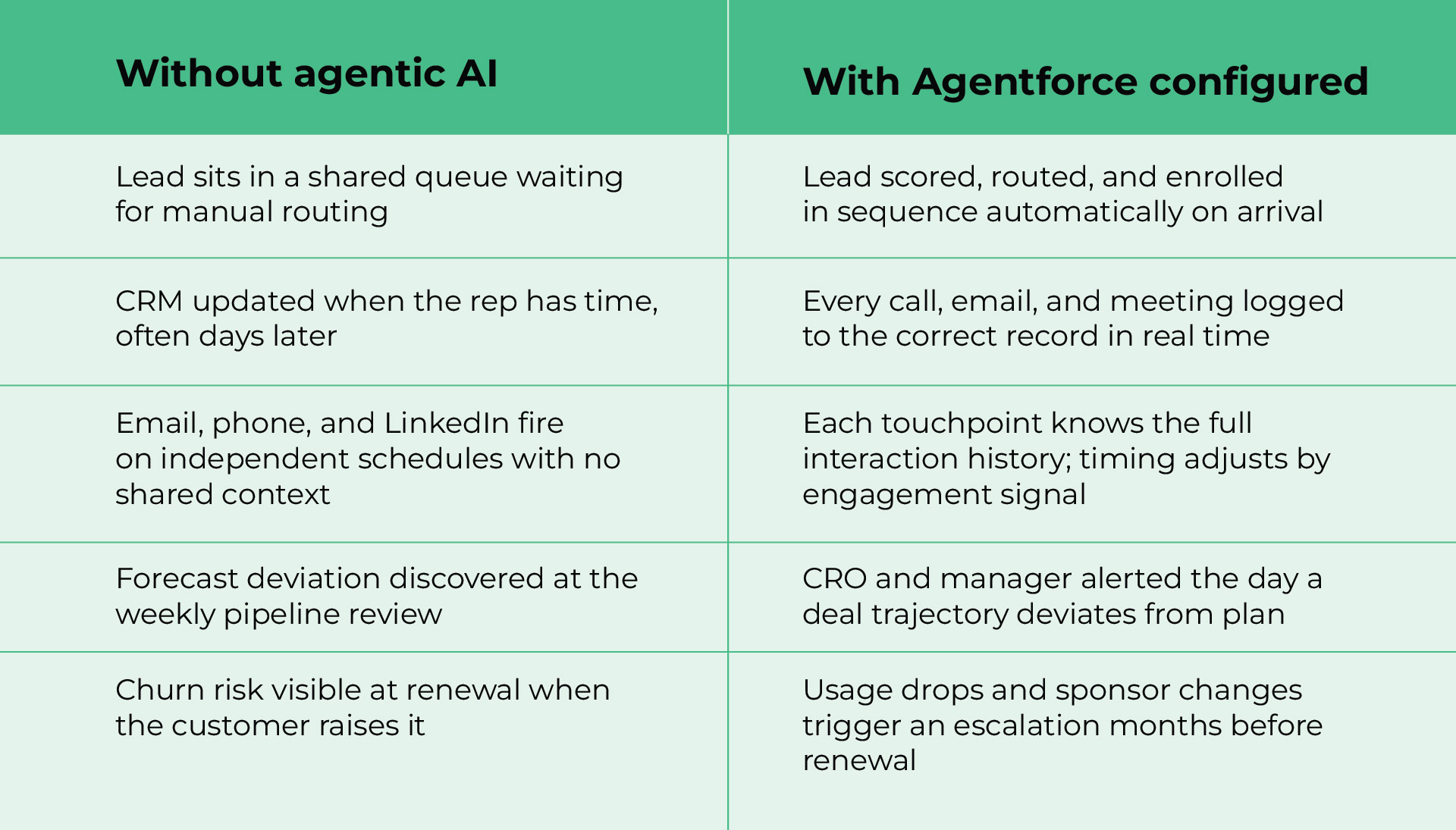
When Agentforce is configured against your ICP, those steps happen the moment a lead arrives. The agent scores it against your ideal customer profile using real-time enrichment data, routes it to the right rep, and enrolls it in the appropriate sequence. The rep’s first interaction is with a qualified, context-rich lead, not one sitting in a queue waiting for someone to notice it.
2. From manual logging to a CRM that updates itself
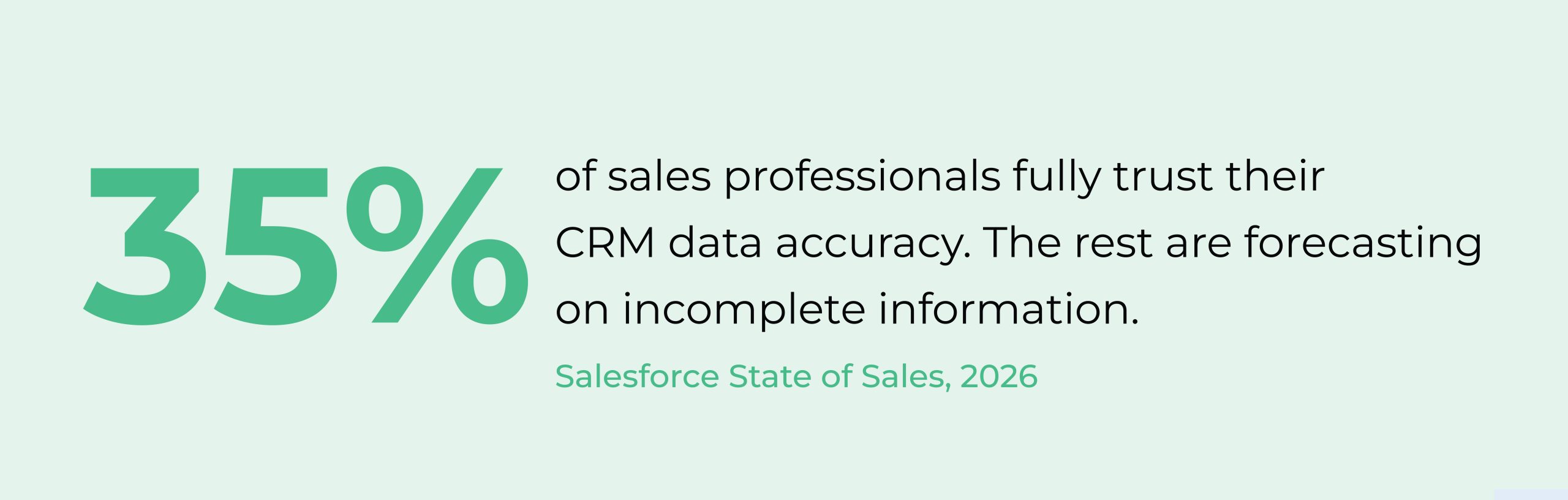
Bad CRM data is the quiet tax on every downstream revenue decision. Forecasting, coaching, handoffs, renewal planning: all of it runs on what the CRM says happened. And only 35% of sales professionals fully trust what it says, according to Salesforce’s own 2026 research.
The cause is structural. Reps log after the fact, under pressure, with incomplete recollection. Busy weeks create gaps. End of quarter creates shortcuts. The CRM becomes a record of what people remembered to type, not what actually occurred.
Agentforce’s activity intelligence layer logs every email, call, and meeting to the correct record automatically, without rep input. The CRM reflects reality, updated continuously. Forecasting becomes more accurate because the data underneath it is complete. Coaching becomes more specific because managers can see what reps are actually doing, not what was entered on Friday afternoon.
3. From parallel noise to coordinated pursuit
B2B buying committees now average 25 stakeholders, up from 16 in 2017. These buyers engage across email, phone, LinkedIn, and in-product channels, often all in the same week. Most revenue teams have tools for each channel. Almost none have those tools coordinated.
The buyer’s experience is fragmented: an email from the sequencing tool, a LinkedIn message from the rep, a call from the SDR, none with context from the others. For the seller, the result is diminishing returns as buyers learn to filter the noise.
Agentforce coordinates outreach with shared context across every channel. Each touchpoint knows what came before it. The agent tracks engagement signals and adjusts the next move accordingly. A buyer who has opened two emails without replying gets a different next step than one who has not engaged at all. The pursuit becomes coherent.
4. From gut-feel forecasting to real-time risk alerts
Forrester research finds that 79% of sales organisations miss their forecast by more than 10%. The primary cause they identify is not rep optimism or bad judgement. It is disconnected systems where forecasting tools operate separately from sales engagement data and CRM activity.
When forecast inputs depend on manual CRM updates, the forecast reflects what was last entered, not what is actually happening in the deal. A rep who had a difficult call on Tuesday but has not logged it yet does not show up as a risk until Friday’s review, or next week’s, or whenever someone notices the deal has gone quiet.
Agentforce’s activity intelligence runs continuously. When a deal’s trajectory deviates from forecast, based on changes in engagement frequency, meeting attendance, or email response patterns, the CRO and relevant manager receive an alert the same day. Intervention becomes possible before the quarter closes, not after it does.
5. From reactive renewals to proactive retention
74% of B2B revenue comes from existing customers (ChurnZero, 2025). For most mid-market companies, protecting net revenue retention is as important as new pipeline. Yet most revenue teams have significantly less operational infrastructure around retention than around acquisition.
The signals that predict churn are available months before the renewal conversation. Usage frequency drops. Support ticket volume climbs. A key executive sponsor leaves or changes roles. Engagement with the customer success team goes quiet. These signals exist in your systems. What most teams lack is the infrastructure to correlate them continuously and act before the customer has already made their decision.
Agentforce monitors these signals across Salesforce, your support platform, and product usage data. When a combination crosses a defined threshold, the account is escalated to the right CSM with a recommended next action. Retention becomes a proactive operation, not a reactive conversation that starts too late.
What makes these five gaps worth solving together rather than one at a time is the way they compound. Faster lead response produces better CRM data because reps are acting on fresher information. Better CRM data improves forecast accuracy. More accurate forecasting gives CSMs earlier visibility into at-risk accounts. Coordinated outreach improves the quality of engagement signals that feed into all of it.
Closing one gap helps. Closing all five changes the architecture of how the revenue team operates. That is what the CROs ahead of this curve are actually building: not a faster version of the same motion, but a different one.
If you want to go deeper on the implementation side, the business case, and what to look for in an implementation partner, we put it all in one place.
Sources
- Salesforce State of Sales, 2026: salesforce.com/news/stories/state-of-sales-report-announcement-2026
- ChurnZero Customer Revenue Leadership Study, 2025: churnzero.net
- Artemis GTM, Speed to Lead Benchmark 2026: artemisgtm.ai/research/speed-to-lead-benchmark-2026
- Forrester Research, forecast accuracy (cited via Outreach, 2026): outreach.io/resources/blog/best-sales-forecasting-software
- Kondo, The State of B2B Sales 2025: trykondo.com/blog/b2b-sales-report-2025